The Eye Report: Tackling Inflammation, Eyelid Margin Disease, and Corneal Nerve Health Supplement
This course is approved for 0.5 hours of CE.
Log in to fulfill the requirements for free in our secure environment, the Learning Center.

The Eye Report: Tackling Inflammation, Eyelid Margin Disease, and Corneal Nerve Health
Diagnosing, treating, and communicating with patients about their ocular surface health.
INTRODUCTION
Ocular surface disease (OSD) is increasingly recognized as a complex, multifactorial condition that extends beyond the traditional dry eye paradigm. Meibomian gland dysfunction (MGD), Demodex blepharitis (DB), inflammation, and corneal nerve health are interconnected contributors to OSD that can affect not only patients’ eye comfort, visual quality, and surgical outcomes but also overall quality of life. In a recent interactive virtual live education broadcast, Marc R. Bloomenstein, OD, FAAO, and Douglas K. DeVries, OD, shared insights into the etiology, diagnosis, and treatment strategies for managing complex ocular surface and eyelid margin disorders. Additional faculty including Lindsay Bull, OD, FAAO, Mitch Ibach, OD, FAAO, and Cory J. Lappin, OD, MS, FAAO, shared case presentations on inflammation, eyelid margin disease, and corneal nerve health to demonstrate potential management pathways and customized approaches to caring for patients with OSD. Together, The Eye Report faculty also provided practical approaches for communicating with patients about their condition.
The following excerpts provide a general overview of the program. To watch the entire broadcast, scroll below ↓
Program Directors
Marc R. Bloomenstein, OD, FAAO
Director of Optometric Services and Director of Dry Eye Center of Excellence, Schwartz Laser Eye Center, Scottsdale, Arizona
mbloomenstein@gmail.com
Douglas K. DeVries, OD
Director and Managing Partner and Director of Optometric Residency Program, Eye Care Associates of Nevada, Sparks
drdevries@eyecareassociatesnv.com
Faculty
Lindsay Bull, OD, FAAO
EyeCare Associates of South Tulsa, Oklahoma
DrBull@southtulsaeye.com
Mitch Ibach, OD, FAAO
Vance Thompson Vision, Sioux Falls, South Dakota
mitch.ibach@vancethompsonvision.com
Cory J. Lappin, OD, MS, FAAO
The Dry Eye Center of Ohio, Montgomery
coryjlappinod@gmail.com
UNDERSTANDING UNDERLYING CAUSES AND RISK FACTORS
Over the past 2 decades, eye care practitioners’ understanding of the ocular surface has shifted dramatically, from viewing dry eye disease (DED) as primarily an aqueous deficient disorder to recognizing it as a multifactorial condition in which eyelid margin health, meibomian gland function, and inflammation all intersect.1-3
The evolution in treatment approaches to ocular surface disease (OSD) reflects growing evidence that meibomian gland dysfunction (MGD), Demodex blepharitis (DB), inflammatory stress, and corneal nerve are not isolated conditions but overlapping mechanisms that together drive OSD. Appreciating the root causes of and risk factors for each of these conditions is the foundation for effective diagnosis and long-term management.
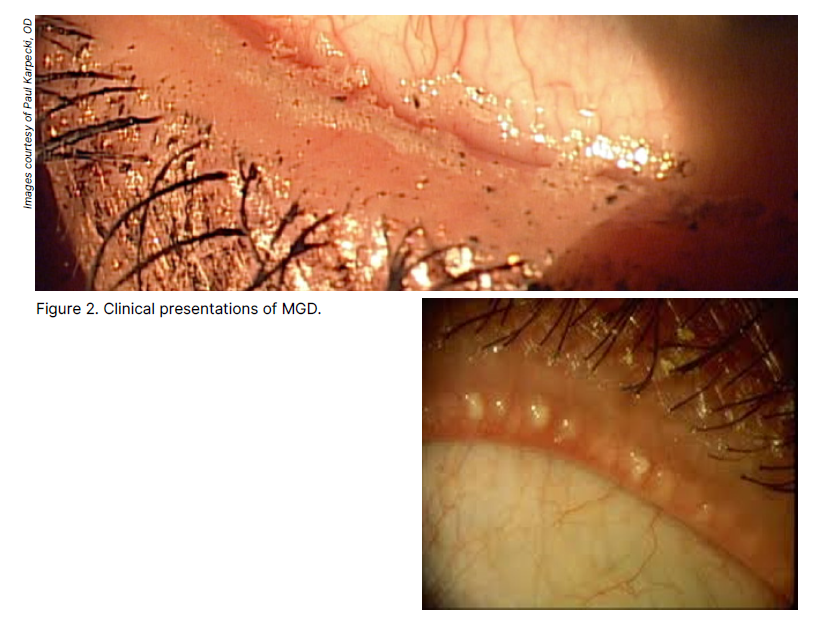
Meibomian gland dysfunction. MGD (Figure 1) is the leading cause of evaporative DED, resulting from either hyposecretion or obstruction of the meibomian glands.4,5 According to The Eye Report faculty, when the glands fail to secrete lipid properly, tear film stability is compromised, leading to chronic inflammation and patient discomfort.
Age, hormonal changes, environmental stressors, and chronic blepharitis are recognized risk factors for MGD. The Eye Report faculty emphasized that contact lens wear and digital device use may exacerbate gland dropout. Since gland atrophy may begin as early as 20 or 30 years old, diagnosis and management is more important than ever before. Even so, MGD is commonly underdiagnosed and undertreated, possibly because the disease is more frequently asymptomatic than symptomatic.6,7 In early or nonobvious stages, patients may exhibit minimal symptoms despite significant gland obstruction, making it essential for eye care practitioners to look beyond patient complaints and perform a routine lid margin evaluation.
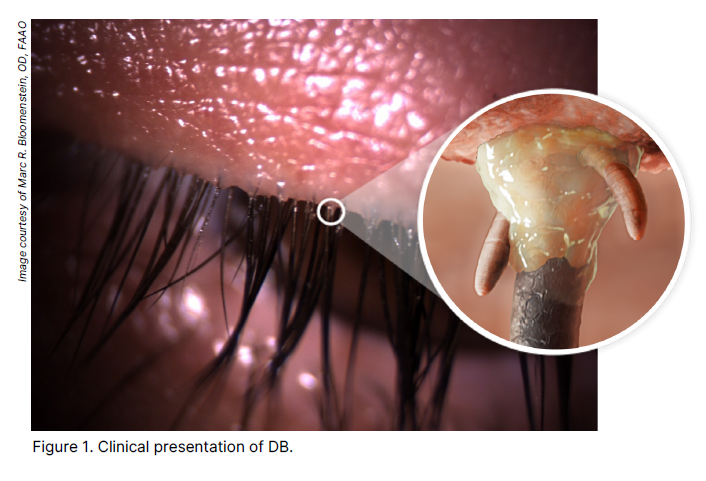
Demodex blepharitis. Demodex mites, particularly Demodex folliculorum and Demodex brevis, colonize the lash follicle and meibomian glands, contributing to inflammation and secondary bacterial overgrowth (Figure 2). Demodex isn’t just a nuisance. It drives chronic blepharitis if it goes untreated and is a major piece of the inflammation cycle.
Even patients with minimal symptoms may have underlying infestation that complicates OSD management. The Eye Report faculty also noted that DB often coexists with MGD,8 creating a self-reinforcing cycle of inflammation. Risk factors include age, immune suppression, and poor eyelid hygiene, making accurate identification and treatment essential.
Inflammation and corneal nerve health. Ocular surface inflammation is both a consequence of and contributor to MGD. Cytokine elevation and oxidative stress disrupt tear film homeostasis, further destabilizing the ocular surface.
OSD is not easily managed without addressing inflammation. Elevated inflammatory markers often correlate with nerve disruption, which can influence both comfort and visual quality. The Eye Report faculty also explained that corneal nerve health is an underappreciated factor that can guide both diagnosis and prognosis. Emerging evidence suggests that compromised corneal nerves may also affect tear reflex sensitivity, leading to a paradoxical reduction in tear production despite surface irritation.9
DIAGNOSTIC TOOLS AND TECHNIQUES
A comprehensive evaluation of the ocular surface requires both subjective and objective assessment. The Eye Report faculty emphasized a multi-modal approach to capture the nuances of MGD, DB, inflammation, and corneal nerve integrity.
Clinical examination. A slit-lamp examination is the cornerstone of an ocular surface assessment. Lid margin telangiectasia, lash debris, lash collarettes, and meibomian gland expression should be evaluated. Taking time to express glands manually to reveal the quality of meibum can reveal early dysfunction that imaging alone may miss.
The Eye Report faculty highlighted the importance of corneal sensitivity testing in patients with chronic symptoms. Simple tools like esthesiometers, a cotton wisp, and dental floss can help detect corneal sensitivity and point to subtle nerve compromise. This may help differentiate neuropathic pain from evaporative or aqueous deficient dry eye.
DB is highly prevalent but underdiagnosed in clinical practice.10,11 The easiest way to diagnose DB is to have patients look down during a routine slit-lamp examination. If collarettes are present, DB may be confidently diagnosed.12
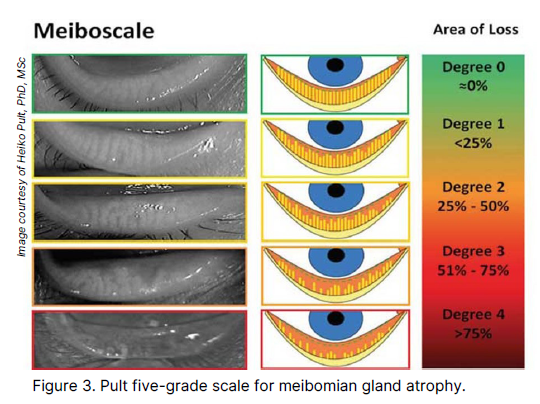
Imaging and biomarkers. Meibography provides visualization of gland dropout and gland atrophy (Figure 3), facilitating both diagnosis of and monitoring for MGD. Additionally, inflammatory biomarkers such as matrix metalloproteinase-9 (MMP-9) may be measured via point-of-care testing. MMP-9 is a more sensitive diagnostic marker than clinical signs of OSD and DED. Elevated MMP-9 in tears correlates with ocular surface inflammation and predicts response to anti-inflammatory therapy.13 The Eye Report faculty highlighted that incorporating biomarker testing allows eye care practitioners to tailor treatment rather than relying solely on symptom reports.
Tear osmolarity measurement is another valuable tool. Hyperosmolar tears indicate compromised tear film homeostasis, and repeated measures can track disease progression and therapeutic response to treatment.
Patient questionnaires. Structured symptom questionnaires including the Ocular Surface Disease Index (OSDI) complement objective findings by capturing subjective impact. Although patients often underreport subtle symptoms, a standardized questionnaire provides a baseline and can reveal discrepancies between patient perception and clinical signs to guide therapy.
CURRENT AND EMERGING TREATMENT OPTIONS
Management of OSD requires a tailored approach that addresses the underlying etiology and patient-specific factors. Treatment strategies may include in-office interventions, prescription therapies, and at-home maintenance.
Mechanical expression and thermal treatment. Both manual meibomian gland expression and thermal treatments help restore gland function by liquefying stagnant meibum. For moderate to severe MGD, combining expression with warm compresses can improve lipid layer quality and tear film stability, The Eye Report faculty remarked.
Another option in this category is the in-office use of either a thermal pulsation system that uses controlled heat and pressure to express liquified meibum from obstructed glands or light therapy to reduce inflammation and improve meibomian gland function. Intense pulsed light (IPL) treatments have gained traction as an adjunct for MGD, targeting telangiectatic vessels and reducing inflammatory mediators to improve meibum quality. IPL therapy combined with low level light therapy has been shown to improve tear breakup time and MGD grading scores13 and increase cellular metabolism to further improve MGD symptoms and meibum expressibility.14
Moisture chambers, meibomian gland probing, and radiofrequency are some of the other options.
Demodex eradication. Topical lotilaner has emerged as an effective first-line therapy for DB. In the experience of The Eye Report faculty, targeted anti-Demodex treatment may reduce collarettes and improve patient comfort within weeks.
Pharmacologic anti-inflammatory strategies. Anti-inflammatory pharmacologic agents including cyclosporine and lifitegrast are central to controlling ocular surface inflammation. Addressing the inflammatory component can prevent gland dropout and protect corneal nerves The Eye Report faculty said, noting early intervention yields better long-term outcomes.
Several cyclosporine formulations are available, each offering unique advantages in terms of concentration, vehicle, and tolerability.
Cyclosporine 0.05%. This formulation is a mainstay for stimulating tear production and restoring homeostasis by suppressing T-cell–mediated inflammation. However, some patients may experience a transient burning or stinging sensation upon instillation due to its oil-in-water emulsion base.15
Cyclosporine 0.09%. A proprietary nanomicellar technology is used in this formulation to enhance drug solubility and penetration through the aqueous tear layer and corneal epithelium.16 Cyclosporine 0.09% provides a higher concentration of cyclosporine to target tissues with less irritation. For some patients, that may mean faster relief and better compliance, according to The Eye Report faculty.
Clinical trials have shown measurable increases in Schirmer scores and tear break-up time, and some patients reported symptomatic improvement within 4 to 6 weeks of consistent use.17
Cyclosporine 0.1%. The water-free semifluorinated alkane (SFA) vehicle of cyclosporine 0.1% avoids the need for emulsifiers or preservatives, allows prolonged surface residence time, and enhances bioavailability.18 Its anhydrous formulation also minimizes the stinging sensation often reported with aqueous or emulsion-based drops.
In contrast to cyclosporine’s mechanism of action, lifitegrast 5% acts by blocking the interaction between lymphocyte function-associated antigen-1 and intercellular adhesion molecule-1, interrupting T-cell activation and cytokine release earlier in the inflammatory cascade. Lifitegrast may be particularly valuable for patients whose main complaint is discomfort or irritation, according to The Eye Report faculty. It may provide faster relief than a patient may experience with cyclosporine.
Together, cyclosporine and lifitegrast therapies give eye care practitioners flexibility to customize treatment based on disease severity, symptom profile, and patient tolerance. Some practitioners alternate or layer the two agents in challenging cases, using lifitegrast initially for faster comfort and then transitioning to a cyclosporine formulation for long-term immunomodulation. Having multiple pharmacologic tools helps personalize care, The Eye Report faculty concluded, allowing eye care practitioners align the right medication with each patient’s expectations, whether that means improved comfort, better tear stability, or lasting protection against chronic inflammation.
PATIENT COMMUNICATION AND EXPECTATION SETTING
Effective management of OSD extends beyond clinical interventions. Clear communication with patients and realistic expectation setting are crucial for adherence and satisfaction.
The Eye Report faculty emphasized the importance of educating patients on the chronic nature of OSD. Patients often expect immediate relief from an OSD treatment, but by framing the condition as a long-term management plan, they may be more likely to adhere to therapy.
According to The Eye Report faculty, visual aids such as meibography images help patients understand the structural changes in their glands and the rationale for treatment. Additionally, they suggested leveraging other objective metrics, including tear osmolarity and MMP-9 to provide tangible evidence of improvement. Showing patients their own data over time helps reinforce adherence and build trust, The Eye Report faculty said.
Another helpful tactic to encourage compliance is to focus on shared decision-making by providing patients with a menu of therapeutic options that may be beneficial for their specific condition. As commented by The Eye Report faculty, when patients understand why each step is necessary, whether it’s a prescription drop, mechanical expression, or IPL, they are more invested in the outcome.
Since recovery and symptom improvement can take weeks to months, communicating anticipated timelines clearly is crucial. Patients are more satisfied when they know what to expect and can see incremental progress, The Eye Report faculty said.
CONCLUSION
OSD is a multifaceted condition influenced by myriad manifestations including MGD, Demodex infestation, inflammation, and corneal nerve health. The Eye Report faculty agreed that a structured, multimodal approach that encompasses comprehensive diagnostics, targeted therapy, and patient-centered communication is essential for effective management. The integration of clinical evidence, emerging treatments, and patient engagement strategies allows optometrists to not only alleviate symptoms but also preserve ocular surface integrity and enhance visual outcomes.
As the field of OSD continues to evolve, eye care practitioners must stay abreast of new diagnostic tools and therapies while maintaining a holistic approach that considers both physiological and patient-reported outcomes. With thoughtful evaluation, personalized treatment, and clear communication, optometrists can make a meaningful impact on ocular surface health and patient quality of life.
Watch the full recording here:

This course is approved for 0.5 hours of CE.
Log in to fulfill the requirements for free in our secure environment, the Learning Center.